
SS304 vs. SS316: Which Stainless Steel is Best for UAE Marine & Coastal Projects?
If you're working on anything near the coast in the UAE, picking the right stainless steel grade isn't just a material choice—it's the difference between something that lasts and something that starts falling apart in a couple of years.
The environment here is brutal. You've got humidity that never quits, salt in the air constantly, temperatures that hit ridiculous highs, and if you're anywhere near the water, direct seawater exposure. All of that eats away at materials faster than you'd think.
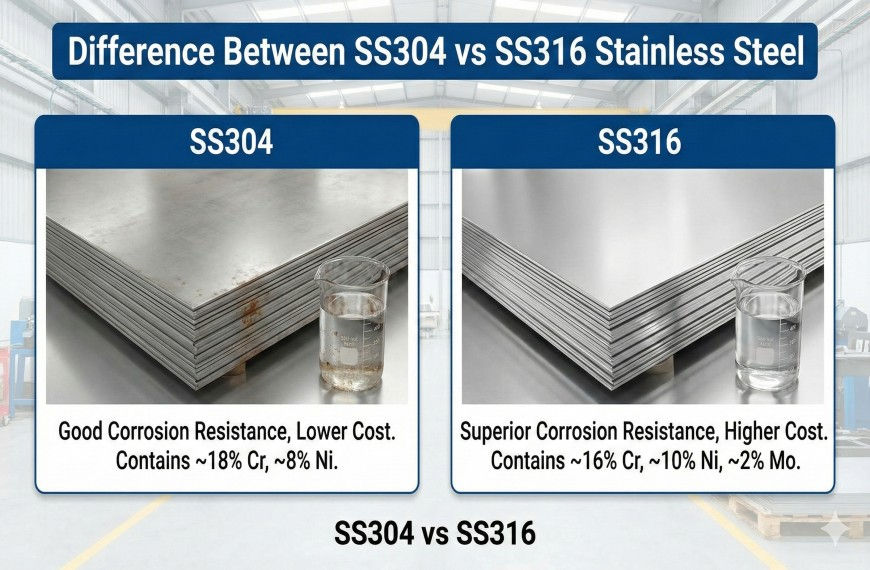
SS304 and SS316 are the two stainless steel grades. They look pretty much the same at first look, but there are some key differences between ss304 and ss316. This guide will help you to find which material is better.
What is SS304 Stainless Steel?
SS304 is basically the default stainless steel. It's used for construction, indoor stuff, and general fabrication. People like it because it's affordable, easy to work with, and does fine in normal conditions.
Key Properties of SS304:
18–20% chromium, 8–10.5% nickel
Decent resistance to rust and oxidation
Easy to weld and shape
Cheaper than SS316
Limitations in Coastal Projects
SS304 doesn't like salt. In marine environments, it starts to corrode pretty quickly. You'll see pitting, crevice corrosion, surface rust—especially if it's anywhere near seawater or even just salt spray.
In places like Dubai, Abu Dhabi, Sharjah, Fujairah—basically anywhere along the coast—SS304 just doesn't hold up long-term. The salty air alone is enough to cause issues.
What is SS304 Stainless Steel?
SS316 is specifically designed for harsh, corrosive environments. The big difference? Molybdenum. That's the ingredient that makes it way better at handling chlorides and saltwater.
Key Properties of SS316:
16–18% chromium, 10–14% nickel, and 2–3% molybdenum
Much better corrosion resistance, especially in marine settings
Handles high humidity and heat without breaking down
Lasts way longer with less maintenance
Why it works so well in the UAE:
The combination of coastal air, high salinity, direct sun, extreme heat, and seawater contact—SS316 handles all of it. It's built for exactly these conditions. Industrial zones near ports, offshore platforms, anything touching the Gulf—this is where SS316 makes sense.
SS304 vs. SS316 : Quick Comparison
Feature | SS304 | SS316 |
Corrosion resistance | Moderate | Excellent |
Saltwater performance | Poor to fair | Excellent |
Has molybdenum | No | Yes |
Good for marine use? | Not recommended | Highly recommended |
Initial cost | Lower | Higher |
Long-term maintenance | Higher | Lower |
UAE coastal durability | Limited | Superior |
Best Choice for Marine & Coastal Projects
Use SS316 for:
Marine railings, balustrades
Coastal building facades
Boat fittings, yacht hardware
Offshore platforms, docks
Pool structures near the sea
Desalination plants, seawater pipelines
Use SS304 for:
Indoor stuff
Projects away from the coast
Dry environments with no salt exposure
Decorative elements that won't see saltwater
ss304 and ss316
SS316 costs more upfront. But here's the thing—with SS304 in coastal areas, you're paying later. Repairs, surface treatments, sometimes full replacements because of corrosion damage. It adds up fast.
With SS316, you get:
Longer lifespan
Way less maintenance
Better structural integrity over time
Actually saves money in the long run
UAE Standards and What Engineers Recommend
Most consultants, engineers, and even municipalities in the UAE will tell you to use SS316 for anything coastal or marine. It's not just a preference—it's often required because of:
Environmental exposure regulations
Safety and durability standards
International marine engineering codes
Which One Should You Choose? For UAE marine and coastal work, SS316 is pretty much the only choice that makes sense.
SS304 is fine for general, indoor, non-marine stuff. But SS316? That's what's built for saltwater, humidity, and the harsh coastal conditions you get around the Arabian Gulf.
If you want something that's going to last and not need constant attention, go with SS316.
Need Help Figuring This Out?
If you're working on a marine, coastal, or offshore project in the UAE and need help with material selection, fabrication specs, or compliance stuff, reach out. Happy to point you in the right direction.
Frequently Asked Questions
1) Which is better, SS304 or SS316?
Depends on where you're using it. SS316 is better if there's moisture, salt, or chemicals involved—especially near the coast. SS304 works fine indoors or in non-corrosive settings. It's all about the environment.
2) What is 304 SS material?
It's austenitic stainless steel—mostly chromium (18–20%) and nickel (8–10.5%). One of the most common stainless grades because it's affordable and versatile.
3) Is 304 stainless steel good quality?
Yeah, it's good quality for what it's meant to do—general-purpose stuff like kitchen equipment, indoor architecture, commercial fittings. Just not great for harsh environments.
4) Is SS 304 rust proof?
It's rust-resistant, not rust-proof. It holds up fine in normal conditions, but throw chlorides or saltwater at it and it'll start to corrode.
5) Does 304 rust in water?
Not in clean freshwater, usually. But in saltwater, hard water, or anything with high chloride content? Yeah, it'll rust or develop pitting over time.
6) What is SS 316 material?
It's stainless steel with chromium, nickel, and molybdenum (2–3%). That molybdenum is what gives it much better resistance to chlorides and saltwater.
7) What is SS316 material equivalent to?
Internationally, it's the same as:
EN 1.4401 / 1.4404
AISI 316
DIN X5CrNiMo17-12-2
8) Is 304 more expensive than 316?
No. SS304 is cheaper. SS316 costs more because of the molybdenum, which makes it more corrosion-resistant.


Comments